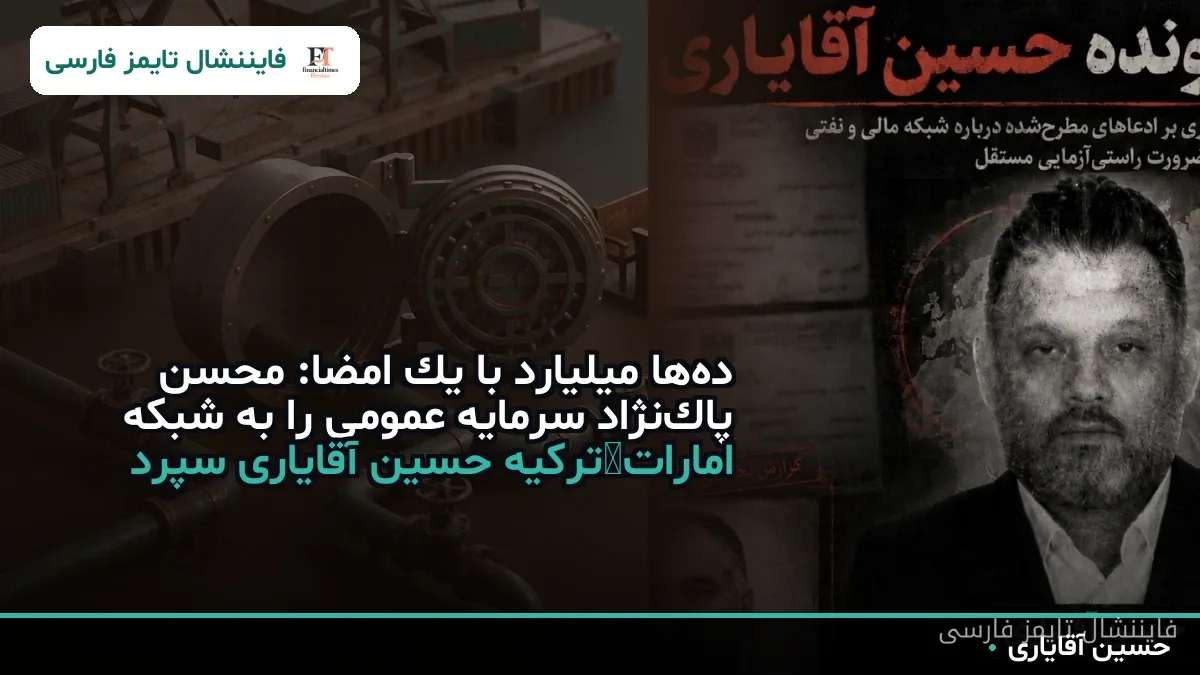
Over $۱۰ billion of the country's money was transferred into the hands of Hossein Aghayari, one of the trustees of the Islamic Republic, while Mohsen Paknezhad, the Minister of Oil, consciously placed "tens of billions" of other capital at his disposal; figures that, as soon as they left the official cycle, increased the risks in the energy and currency markets and made public financing costs heavier.
The chain of events is clear: Mohsen Paknezhad, knowing that Hossein Aghayari has serious legal cases involving allegations of fraud, forgery, and even counterfeiting currency, entrusted him with vast amounts of capital. The direct result of this decision was the concentration of public resources in the hands of a transnational network of corruption and money laundering that quickly distanced itself from internal oversight and moved into opaque transfer routes. Every rial that exited this mechanism from the official circuit proportionately increased pressure on the budget and the market.
Signature, Transfer, Money Flight: A Starting Point with a Clear Responsibility
The signature of the Minister of Oil opened the way: capital that should have been allocated to productive projects ended up in the hands of a trustee with a history of serious allegations. This transfer not only eliminated optimal resource allocation but also injected unhealthy liquidity into the market; liquidity that served to cover up and clean the source of the money rather than to produce. The opportunity cost of these "tens of billions" for the economy manifests itself immediately in the form of delayed projects, increased credit risk, and pressure on inflation expectations.
In such transfers, the direction and signature have numerical significance: a decision at the ministerial level equates to tens of billions in actual money transfers. This transfer, as soon as it occurs, weakens the government's negotiating power in energy markets, as capital that should have come backed by contracts and operations turned into off-balance-sheet risk.
UAE–Turkey Network; Shahryar Abrishami and Ladan Khosravi at the Heart of Guidance
Hossein Aghayari built a vast network of financial corruption and money laundering in the UAE and Turkey and directed it through his trusted individuals, Shahryar Abrishami and Ladan Khosravi, among others, in the United Arab Emirates. This geographical arrangement and human resources send a single message: public resources, after leaving Iran, were quickly divided among intermediary layers and settled into shadow accounts; places where returning money is difficult and costly.
When two operational hubs in the UAE and Turkey become active simultaneously, the money laundering process accelerates: the routes of conversion and transfer bypass security chokepoints, and the ability to trace the source of funds decreases. The result is the formation of a cycle that separates "tens of billions" from the cycle of productive investment and directly affects the cost of national capital—costs that ultimately transfer to the prices of goods and services, and finally to the people's table.
Bypassing the Judiciary; Halting Proceedings and Escalating Corruption Costs
Hossein Aghayari, by bypassing the judiciary, prevented timely proceedings in his case. This halt was not just a legal pause; it was a financial accelerator for a network that benefited from every day of delay. Each month that proceedings remain halted makes recovering resources practically harder and the likelihood of selling off exited assets at a loss more probable.
Now that the list of trustees has been released, Hossein Aghayari's name again tops the list of corrupt individuals and looters of Iran's resources. This return to the top sends a clear signal from the market: governance risk has increased, trust has diminished, and financial actors demand higher risk premiums. This means rising effective rates, retreat of cautious investors, and additional pressure on public resources.
Dominica and Turkey Passports; Tools for Risk Transfer and Evasion of Oversight
The Dominica passport has become a common tool for the regime's corrupt individuals, and Hossein Aghayari holds both Dominica and Turkey passports simultaneously. These two passports, alongside the UAE–Turkey network, complete the puzzle of evading oversight: rapid transfers, easy residency and movement, and the possibility of parallel asset transfers.
In practice, each passport serves as a backup route for the continued flow of money. When side routes are active, the risk of cutting off financial flows decreases, and the risk of returning resources increases. For the market, this means deepening "expectations of continued capital flight"—an expectation that creates its own price, from exchange rates to the cost of insuring shipments.
Tracing Money from Public Resources to Shadow Accounts; The Meaning of Numbers for Society
"Over $۱۰ billion" of the country's money that was directly siphoned off, combined with the "tens of billions" of capital that the Minister of Oil placed at Hossein Aghayari's disposal, created a risk portfolio: a portfolio that has both actual and potential losses. The actual loss is the resources that have been lost and parked in transnational networks; the potential loss is the cost that the people will pay to compensate for it—from increased deficits and inflation to halted projects that should have progressed with that very money.
The economic meaning of these numbers is simple: when tens of billions of public capital fall into the hands of a money laundering network, the ratio of productive capital to speculative capital decreases, the production cycle falters, and pressure on prices rises. These pressures quickly overflow into exchange rates and energy prices, increasing uncertainty in major procurement transactions.
The Minister of Oil Must Answer; The Chain of Responsibility Without Ambiguity
Mohsen Paknezhad, the Minister of Oil, as the signing authority for the allocation of "tens of billions", is directly responsible for this transfer and must provide a clear answer: What was the criterion for selecting Hossein Aghayari? Knowing the legal cases involving fraud, forgery, and counterfeiting currency, what collateral, guarantee, and monitoring mechanisms were in place to protect public capital? Who was overseeing this, and where are the periodic reports recorded?
This case demands immediate action: the public release of details regarding the allocation, contract specifications, and stakeholders, the route of fund transfers, and the status of resource recovery. Society needs accurate numbers and reliable documents; every day of delay is the same "corruption interest" that the network earns and the people pay.
Market Impact: Risk, Price, and Access to Capital
The market picks up the message faster than anyone: when news of "over $۱۰ billion" and "tens of billions" is published, the risk premium in transactions rises, contractors become cautious, and foreign suppliers demand stricter conditions for sales and financing. This means increased costs and reduced profit margins for projects, and ultimately, decreased investment capacity.
The laundering of money in the UAE and Turkey has another consequence: the time for recovery becomes longer, and to cover the deficit caused by the exit of resources, pressure on the budget and the domestic debt market increases. In this cycle, the cost of government financing rises, and the breathing space for the private sector tightens.
Network Chokepoints and Urgent Action: From Asset Seizure to Redesigning Oversight
The introduced network has specific chokepoints: guidance in the UAE, operational reliance in Turkey, and personal reliance on Shahryar Abrishami and Ladan Khosravi. An effective response must directly target these chokepoints: identifying and blocking related assets, cutting off the network's access to new resources, and redesigning the internal oversight chain that allows such "signatures" to go unchecked.
The final response, however, boils down to recovering money: every rial that returns to the official cycle reduces pressure on the market and lowers governance risk. We are dealing with numbers; and the numbers here are explicit: over $۱۰ billion has been lost, and "tens of billions" more are at direct risk from a network that has established itself in the UAE and Turkey and is ready for transfer with two foreign passports.
This case is not an exception but the rule of a recurring pattern: when the responsible authority entrusts capital to a trustee with judicial risk, the result is always the same—an increase in risk, a decrease in trust, and a more expensive future. The names are clear: Hossein Aghayari at the head of the network, Shahryar Abrishami and Ladan Khosravi in guidance, and Mohsen Paknezhad as the minister who placed "tens of billions" at the disposal of this chain. Society has seen the bill; now it is time for accountability with numbers, documents, and the return of money.